
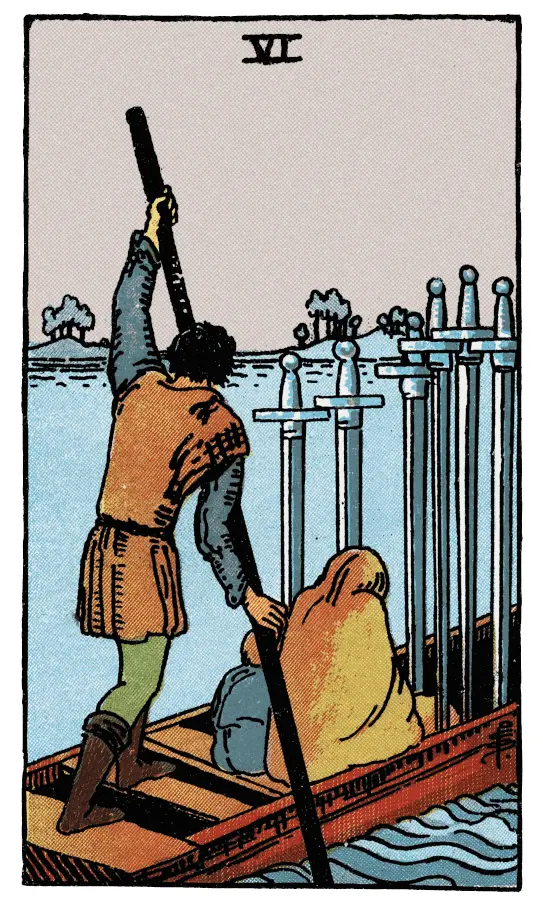
Six of Swords Tarot Meaning: Upright, Reversed, Love, Career & Money
Six of Swords moves from chaos toward calmer water. Recovery isn’t instant—you leave with scars, experience, and tools you still need.
Upright keywords
Reversed keywords
Six of Swords Core message in a spread
Swords correspond to Air—thought, language, truth, choices, and conflict. Notice whether you’re trapped in mental stories or using clear judgement to cut through the issue.
Don’t just memorize keywords. Put this card back into your question, its position, and surrounding cards: if it lands in “present,” it describes the current energy; if in “obstacle,” it points to what’s stuck; if in “advice,” it suggests the next attitude or step.
Key symbols include: small boat, six swords, ferryman, calm water ahead。
Six of Swords Upright meaning
Upright: transition, moving, travel, leaving unhealthy environments, or mental improvement. The path isn’t fully clear, but better than staying put.
In practical readings, upright often means the energy is more available, outward, or easier to use. Ask yourself: have I noticed the resources this card offers, and am I willing to handle them maturely?
Six of Swords Reversed meaning
Reversed: resisting leaving, problems following you, or body moved but mind still stuck.
Reversed doesn’t mean “doomed.” More often it shows blocked energy, excess, delay, or a turn inward. If you drew this card reversed, don’t panic—see which theme fits your current situation most: resisting progress, old problems persist, delayed departure, psychological staying。
Six of Swords Love & relationships
In love: repair after cooling off, leaving painful relationships, or long-distance moves. Healing takes time—don’t force instant joy.
For questions about dating, situationships, reconciliation, or partnership, the point isn’t only “will we be together,” but how to build healthier dynamics. Tarot is most useful when it helps you see patterns—without giving away your agency.
Six of Swords Career, work & study
At work: job change, team switch, leaving high-pressure settings, recovering from failure. Accept transitional instability.
In career questions, use this card to check your strategy, pace, communication, and resource use. If it points to resistance, break the issue into actionable parts—often more effective than waiting for the environment to change.
Six of Swords Money & practical matters
Financially: gradual improvement; may need debt restructuring or steadier plans.
Financial meanings are not guarantees of profit or loss. Treat this as a reminder about risk awareness, resource allocation, and behavior patterns—then return to checkable realities like budgets, contracts, time, and responsibility.
Six of Swords Inner message
Inside: healing is a journey. You can move forward with pain—you need not wait until it’s gone.
Reflection: What am I leaving—and which experiences should I actually take with me?
Six of Swords Action advice
- Accept the transition period.
- Don’t bring old problems into new environments.
- Find support to help you cross.
- Leave chaos one step at a time.
FAQs
Is Six of Swords a “good” card?
Six of Swords isn’t best judged as simply “good” or “bad.” It’s more like a reminder: Six of Swords moves from chaos toward calmer water. Recovery isn’t instant—you leave with scars, experience, and tools you still need. If it appears as an outcome or advice position, focus on expressing its energy in a mature, workable way.
Does reversed Six of Swords always mean bad news?
Not necessarily. Reversed often means blockage, excess, delay, or an inward turn. For Six of Swords, themes may include “resisting progress, old problems persist, delayed departure, psychological staying.” Use it as a signal to adjust direction, not as a fixed fate.
What should I do if I draw Six of Swords?
Return to the question and the card position. If it’s an advice card, start here: Accept the transition period.; Don’t bring old problems into new environments.; Find support to help you cross.; Leave chaos one step at a time.. Tarot is most useful when it turns abstract messages into doable choices.